
Refractive Surgery / Ophthalmology · Procedure
Trifocal Lenses
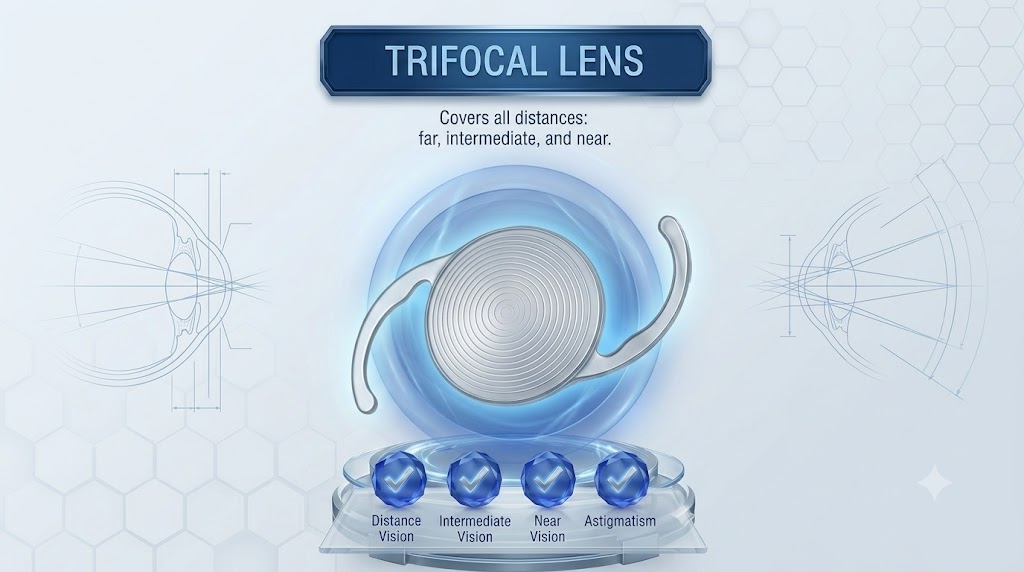
Advanced trifocal intraocular lenses providing excellent distance, intermediate and near vision with maximum spectacle independence.
- Near + Intermediate + Distance
- Vision zones
- ~90–95% of patients
- Glasses independence
- 2.2 mm (same as cataract)
- Incision size
- Same-day
- Hospital stay
- 24–72 hours
- Visual recovery
- Trifocal / EDOF / Multifocal
- Lens options
What it is
Understanding Trifocal Lenses
Trifocal intraocular lenses are designed to provide excellent vision at near, intermediate, and distance. They offer the highest chance of freedom from glasses but require careful patient selection and a period of neuroadaptation.
Benefits
Why patients choose it
- Excellent distance vision
- Excellent intermediate vision
- Excellent near vision
- Glasses free experience
- Highest spectacle independence
Candidacy
Is it right for you?
Who it’s for
- Highly motivated for spectacle independence
- Healthy macula (OCT)
- Stable tear film
- Regular corneal topography
- Alpha & Kappa angle <0.5 mm
- Corneal HOA <0.30 µm
- Realistic expectations
Who it’s not for (yet)
- Macular disease
- Moderate to advanced glaucoma
- Irregular corneas
- Elevated HOAs
- Poor ocular surface
- Unrealistic expectations
How it works
Your procedure, step by step
- 1
OCT, corneal topography, tear film evaluation, and visual needs assessment.
- 2
Confirmation that the patient is an ideal trifocal candidate.
- 3
Phacoemulsification with trifocal IOL implantation.
- 4
Visual recovery with gradual neuroadaptation over the following months.
Compare options
Trifocal Lenses vs other techniques
| Feature | Standard Monofocal IOL | Premium Trifocal IOL ⭐ Recommended |
|---|---|---|
| Distance vision | Yes | Yes |
| Intermediate (computer) | No | Yes |
| Near (reading/phone) | No | Yes |
| Glasses independence | Partial | ~90–95% |
| Halos / glare adjustment | Minimal | 2–6 week neuroadaptation |
| Cost | Standard | Premium upgrade |
| Same procedure | Yes | Yes |
Questions
Trifocal Lenses FAQs
Are trifocal lenses the best?
They are the best option for many suitable patients, but only after careful assessment. The right lens depends on each individual's eye health and lifestyle.
Will I see halos?
Mild halos and glare are common during the early months and usually improve with neuroadaptation.
Would I be glasses free for all distances?
Trifocal lenses provide the highest likelihood of spectacle independence, although individual results vary.